
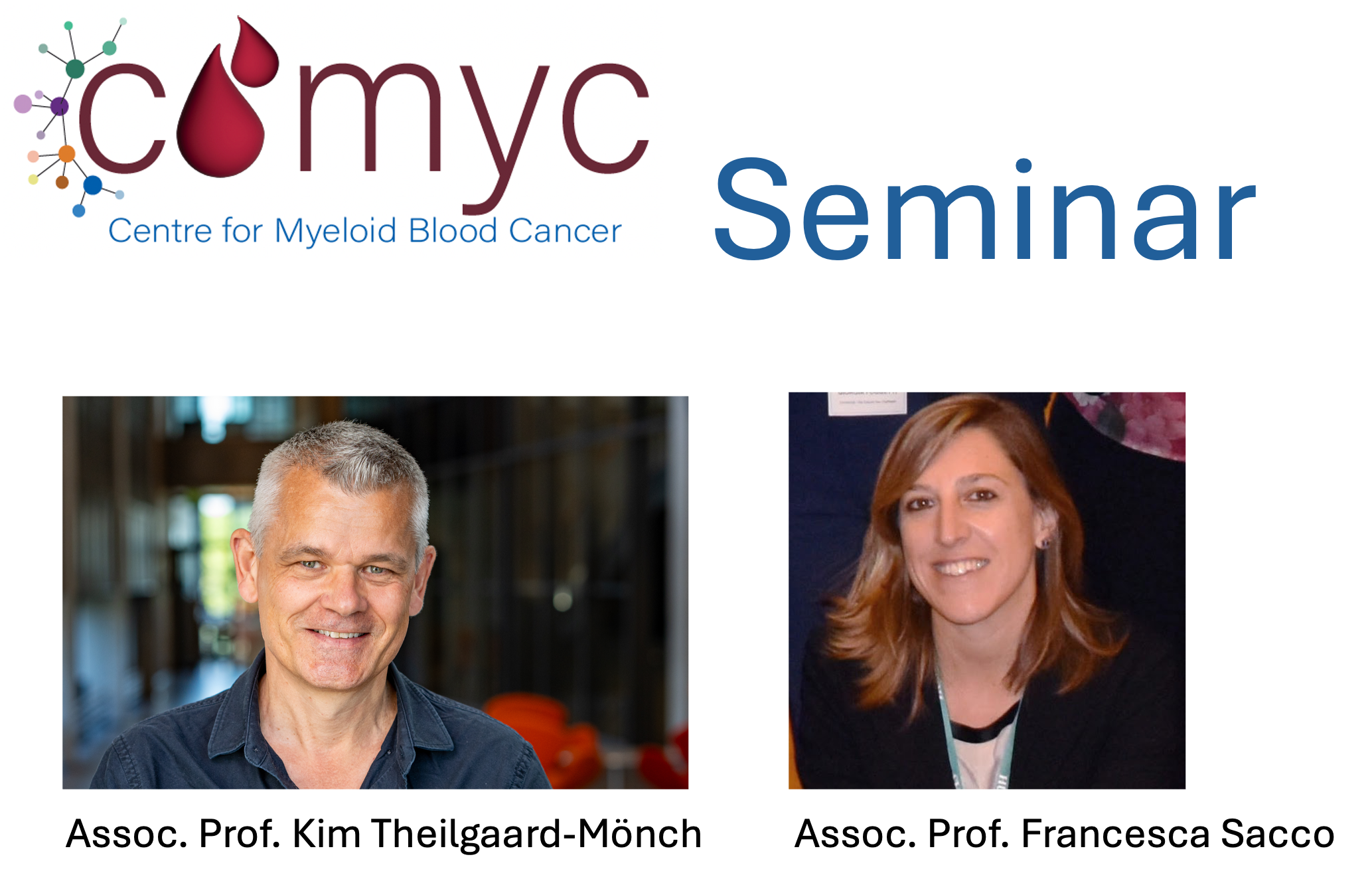
Welcome to the upcoming CMYC mini-seminar
- Date: Friday, February 20th
- Time: 10:15 – 12:00
- Location: Auditorium 4, BB-bygget
with the following two presenters:
10:15 –11:00 Assoc. Prof. Francesca Sacco, Department of Biology, University of Rome Tor Vergata
“A systems biology approach to identify vulnerabilities in therapy-resistant leukemias“
11:00 – 12:00 Assoc. Prof. Kim Theilgaard-Mönch, Biotech Research & Innovation Centre, University of Copenhagen
“The glycosaminoglycan oncofetal chondroitin sulfate represents a novel target for antibody drug-conjugate therapy of acute myeloid leukemia“
Presenter: Assoc. Prof. Francesca Sacco, Department of Biology, University of Rome Tor Vergata
A systems biology approach to identify vulnerabilities in therapy-resistant leukemias
In this presentation, I will show how an integrated systems biology approach combining mass spectrometry–based phosphoproteomics, multiparametric profiling, and network modeling can be used to uncover mechanisms of therapeutic resistance in leukemia. First, I will focus on FLT3-ITD acute myeloid leukemia, demonstrating that the position of the ITD insertion reshapes signaling networks and subcellular proteome organization, thereby determining response to tyrosine kinase inhibitors. I will show how this analysis identifies novel molecular vulnerabilities. Next, I will briefly present how similar phosphoproteomic and network-based strategies reveal BCR::ABL1-independent resistance mechanisms in chronic myeloid leukemia and enable the identification of novel draggable targets eradicating resistant cells. Finally, I will present a new project where we aim to increase leukemic cell immunogenicity by pharmacologically manipulating key signaling pathways.
Presenter: Assoc. Prof. Kim Theilgaard-Mönch, Biotech Research & Innovation Centre, University of Copenhagen
The glycosaminoglycan oncofetal chondroitin sulfate represents a novel target for antibody drug-conjugate therapy of acute myeloid leukemia
Antibody-drug conjugates (ADCs) have emerged as promising targeted therapies in acute myeloid leukemia (AML). However, most ADCs exhibit off-target binding to normal hematopoietic stem and myeloid progenitor cells, resulting in adverse hemato-toxicity and narrow therapeutic windows, limiting their clinical application to young and fit AML patients eligible for intensive curative therapies. Proteoglycans with high levels of the glycosaminoglycan oncofetal chondroitin sulfate (ofCS), are abundantly expressed in solid cancers while being absent or lowly expressed in normal adult tissues. Here, we report high ofCS levels on bone marrow (BM) cells of AML patients and AML patient-derived xenografts (PDXs), while BM cells of healthy subjects showed low or undetectable ofCS levels. Consistently, an anti-ofCS antibody demonstrated binding and internalization into AML cells, and anti-ofCS ADCs effectively killed AML cells in vitro. Moreover, anti-ofCS ADC treatment significantly prolonged survival of AML PDXs compared to controls and was associated with low toxicity. Hence, anti-ofCS ADC could represent an effective therapy with acceptable toxicity applicable for all AML patients, including those ineligible or unresponsive to current intensive curative therapies. In conclusion, our study for the first time demonstrates that a glycosaminoglycan like ofCS represents a druggable target for development of effective antibody-based AML therapies.
 NB
NB